
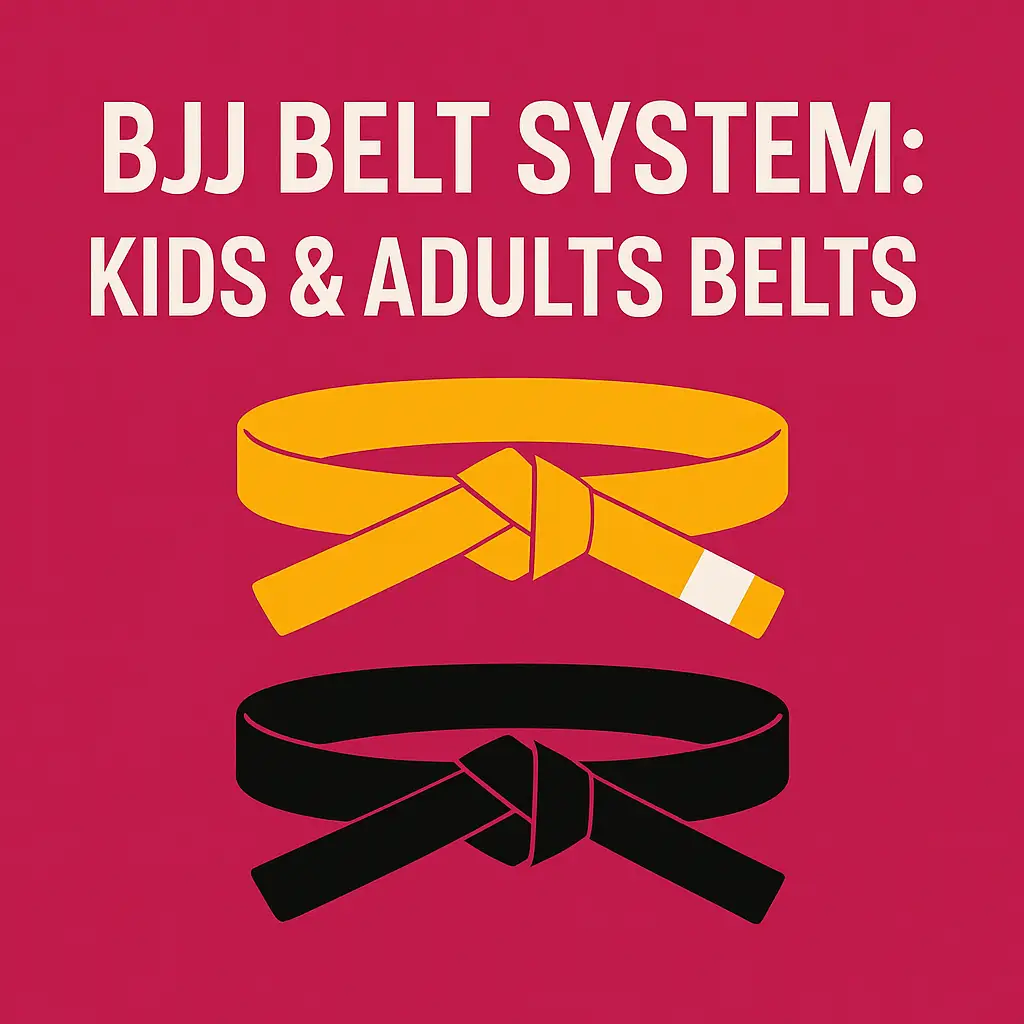
For adults who will be training in Brazilian Jiu-Jitsu, there will be five main belts they will receive: a white belt, a blue belt, a purple belt, a brown belt, the highly coveted black belt. Most people will take about 8 to 12 years to go from white to black belt if they are very consistent with their training process. Not only that, IBJJF sets minimum amounts of time at each belt from blue belt on for high-level competitors. Children under the age of 16 have their own set of belts in between and above black belt sits the coral and red belts that take decades to earn and usually are only held by people with the last name Gracie.
In this post we break down every belt in order, how long each one of them takes, usually, IBJJF’s official minimums, and how stripes or promotions work (typically, because every gym/coach is a bit different).
BJJ Belt Order and Timeline at a Glance
Minimums apply to adults (18 and up) under IBJJF’s graduation system. Typical times vary a lot by how often in individual trains.
If you add up the typical ranges given, most people will land somewhere around a decade from their first class to being a black belt in Brazilian Jiu-Jitsu. The IBJJF minimums add up to about 4.5 years after white belt but almost nobody moves that fast because the far majority of the hobby are hobbyists. Adult world champions at blue, purple, or brown belt are the one exception. IBJJF typically waives the minimum time for them specifically.
Adult Belts
White Belt
Everyone who starts training Brazilian Jiu-Jitsu will start here, whatever your background is. The white belt is typically about survival. Here you’re going to be learning how to escape bad positions, how to not panic under pressure, and how to effectively keep yourself from getting hurt by tapping early. There’s no minimum time and most people who train 2-4 times a week, reach blue belt in 1-3 years after starting at white. It’s also the belt that most people quit so just staying is a real achievement. See what to focus on as a white belt.
Foundational Jiu-Jitsu is a video series from Travis Lutter, created with Paul Halme, one of his world champion black belts. The series covers the core movements, positions and concepts every Brazilian Jiu-Jitsu student needs to earn a Blue Belt.
Blue Belt
Getting to your blue belt means that you understand the fundamentals and can apply them against a resisting partner. You know how to effectively escape, how to hold the top position, and how to finish basic submissions in a lot of different ways.
IBJJF does require you to at least be 16 years old to hold this belt and to spend at least 2 years at blue belt before you go to purple.
There is also a common phenomenon known as the “blue belt blues” that most people at this stage hit. Essentially you lose the shininess of learning something new and a lot of people lose motivation and end up falling off here. Personally I went through this. It is not fun but now I’m more consistent on the mats and aiming to get my purple belt this year.
Read more on blue belt requirements, how long it takes to get a blue belt, and the blue belt blues.
Purple Belt
At purple belt that’s when most people’s game really starts to become their own. Most purple belts understand how to chain techniques together, set traps, and start helping with coaching or teaching within their classes or helping the lower belts progress in some way.
The IBJJF minimum is 18 months at purple belt and you must be 16 years of age or older to hold it.
Brown Belt
At brown belt is where most people start tightening details and filling holes that were previously apparent while they were a purple belt. Brown belt is an adult-only rank. You have to be over 18 years old to hold it and you need at least 1 year at brown before you can progress to black.
At this stage going from brown to black is much more about technique, and a lot of coaches ultimately do look for character qualities in an individual before they get promoted.
When you really think about it, Brazilian Jiu-Jitsu is a tight-knit community of individuals who spend their free time beating each other up and making themselves better athletes on the mat. Through that process you try to become a better person.
When you become a black belt in Brazilian Jiu-Jitsu, you are a part of your coach’s legacy whether you like it or not. It’s a very big deal to go from brown to black so sometimes there are intangible things that are measured when you’re trying to get promoted.
See our guide to the brown belt.
Black Belt
At black belt it effectively means you’ve mastered the fundamentals and can teach them.
The minimum age for this belt is 19 years old unless you’re an adult world champion at brown belt.
The black belt has its own system of degrees earned on a fixed schedule of years or time that you’ve actually held your black belt.
See everything to know about the BJJ black belt and how black belt degrees work.
Beyond Black Belt: Coral and Red
Most of the time you’re never going to run into anybody that holds these belts but after six degrees at black belt comes the red and black coral belt at 7th degree, then the red and white coral belt at 8th degree, and finally the red belt at 9th and 10th degrees.
Getting from black to coral will take you decades, and red belts are among the most senior figures in the sport, most of whom end up having the last name Gracie.
Kids Belts (Ages 4 to 15)
Kids progress through extra belts between white and blue, so they can be recognized for progress over the long stretch before they turn 16:
| Belt | Minimum age | IBJJF minimum time at this belt | Typical time at this belt |
|---|---|---|---|
| White | Any | None | 1 to 3 years |
| Blue | 16 | 2 years | 2 to 4 years |
| Purple | 16 | 1.5 years | 2 to 3 years |
| Brown | 18 | 1 year | 1 to 3 years |
| Black | 19 | Degrees on a fixed schedule | For life |
| Belt | Age range |
|---|---|
| White | Any age |
| Grey | 4 to 15 |
| Yellow | 7 to 15 |
| Orange | 10 to 15 |
| Green | 13 to 15 |
Each kids color also comes in white-striped and black-striped versions, so there are more steps than the five colors suggest. At 16, kids move into the adult system, and an experienced green belt typically goes straight to blue.
How Stripes Work
Stripes are a fun way that shows progress within a specific belt color.
White, blue, purple, and brown belts each have up to four stripes, usually taped onto the black bar at the end of your belt.
Stripes mark progress between the belts. Typically coaches will give them out on a schedule while others only see them as worthy of giving out once they actually see improvement.
There are no rules that say you need to have all four stripes before you actually get a promotion and I’ve seen it myself. Some people go from two stripes straight to the next belt up.
What Actually Gets You Promoted
At the end of the day it’s always at your coach’s discretion who gets promoted and at what time.
Most of the time most coaches won’t really follow the minimums that are recognized by the IBJJF because they don’t govern everybody individually. The IBJJF only sets minimums it will personally recognize.
In actual gyms coaches look at the following:
- How much time you’re actually spending on the mat
- Your skill level against others in similar age ranges
- What you can do in live rolling
- How well you are in competitions
- Understanding your background (wrestlers and judoka often move up faster)
- How you actually train
Being a good partner, controlling your ego, and helping newer students all can play a role in how quickly someone gets promoted.
Injuries, moving gyms, and time off the mats can slow most people down at some point. It’s happened to me. It’s very normal and that’s why these ranges are ultimately so wide and why it takes so long to ultimately reach the black belt.
Frequently Asked Questions
How many belts are there in BJJ?
Five main adult belts (white, blue, purple, brown, black), four extra kids belts (grey, yellow, orange, green), and the coral and red belts above black.
How long does it take to get a black belt in BJJ?
Around 8 to 12 years for most people who train consistently. Very talented, full-time athletes sometimes do it in 5 or 6. The IBJJF minimums alone add up to about 4.5 years after white belt.
Which belt takes the longest?
Below black, blue belt is usually the longest stay, and it has the highest IBJJF minimum at two years. Above black, the jump to coral belt takes decades.
Can you skip a belt in BJJ?
Adults can’t skip a belt under IBJJF rules, though a strong wrestler or judoka may move through white and blue faster than usual. Kids turning 16 can jump from a kids belt straight to blue.
Where can I check the official rules?
IBJJF publishes its full graduation system on ibjjf.com. Check it if you plan to compete, since IBJJF only recognizes promotions that meet its rules.