If you train BJJ long enough, your fingers will take a beating. Between collar grips, sleeve control, and constant pulling, it’s only a matter of time before they start hurting. I learned this the hard way early on, which is why finger taping has become a non-negotiable part of my routine.
This isn’t just about injury prevention, it’s about longevity. If you want to keep training consistently without wrecking your hands, here’s how I personally tape my fingers and when I actually use it.
Why Finger Taping Matters in BJJ
Your fingers are under constant stress in BJJ, especially if you rely heavily on gi grips. Over time, this can lead to:
- Joint inflammation
- Ligament strain
- “BJJ fingers” (crooked, swollen joints)
I started taping when I noticed soreness lingering even after rest days. Since then, it’s helped me train harder and recover faster without worrying about long-term damage.
When I Tape My Fingers
I don’t tape every single session, but I do it strategically. Here’s when I always tape:
- Hard sparring days: More intensity means more grip fighting
- Gi sessions: Way more strain compared to no-gi
- When I feel soreness: Even slight discomfort is a sign to protect early
Sometimes I skip taping during light drilling or no-gi, but if my fingers feel even slightly off, I don’t take chances.
The Tape I Use
I personally prefer thin athletic tape (usually 1–1.5 cm width). It’s easier to wrap, doesn’t restrict movement too much, and stays in place during rolls.
(Also always tear your strips before class starts. You don’t want to struggle with tape while everyone’s already warming up)
How I Tape My Fingers (Step-by-Step)
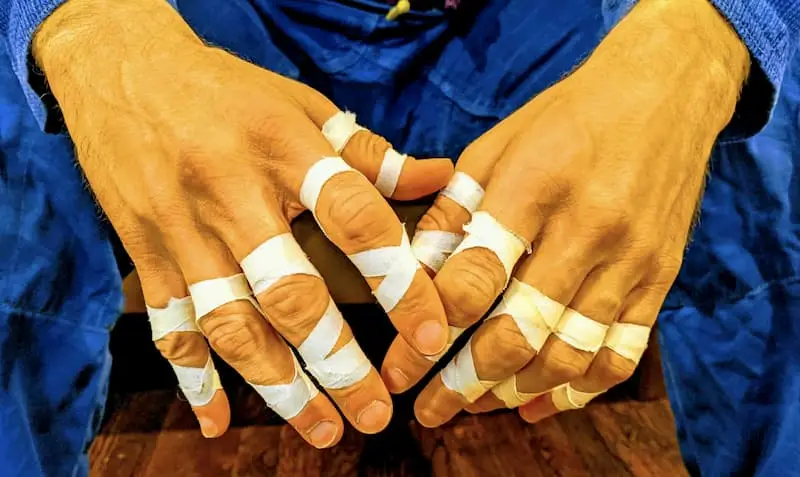
1. Basic Joint Support (My Go-To Method)
This is what I use the most.
- Wrap one layer above the joint
- Wrap one layer below the joint
- Connect both with a strip across the joint (like a bridge)
This helps stabilize the joint without locking it completely. I still get mobility, but way less strain.
2. Buddy Taping (For Minor Injuries)
If one finger is bothering me more than the others, I “buddy tape” it to the finger next to it.
- Place tape around both fingers together
- Don’t wrap too tight, keep circulation normal
I use this when something feels slightly tweaked but not serious enough to stop training.
3. Full Finger Wrap (When It’s Bad)
If my finger is really sore, I go for a full wrap:
- Spiral the tape from base to mid-finger
- Add support around the joints
This limits movement more, but it gives solid protection on rough days.
Mistakes I Avoid
I’ve messed this up before, so learn from me:
- Too tight: Your finger shouldn’t turn purple
- Too loose: It’ll fall off mid-roll
- Over-taping everything: You still need grip and flexibility
Balance is key. You’re supporting the joint, not mummifying your hand.
Finger taping isn’t just for injured grapplers, it’s for smart ones. I see it as part of my gear now, just like my gi or mouthguard.
The biggest lesson I’ve learned is this: don’t wait until your fingers are wrecked. Start early, tape when needed, and your future self will thank you.
Because in BJJ, it’s not just about surviving rounds, it’s about staying in the game long enough to actually get good.