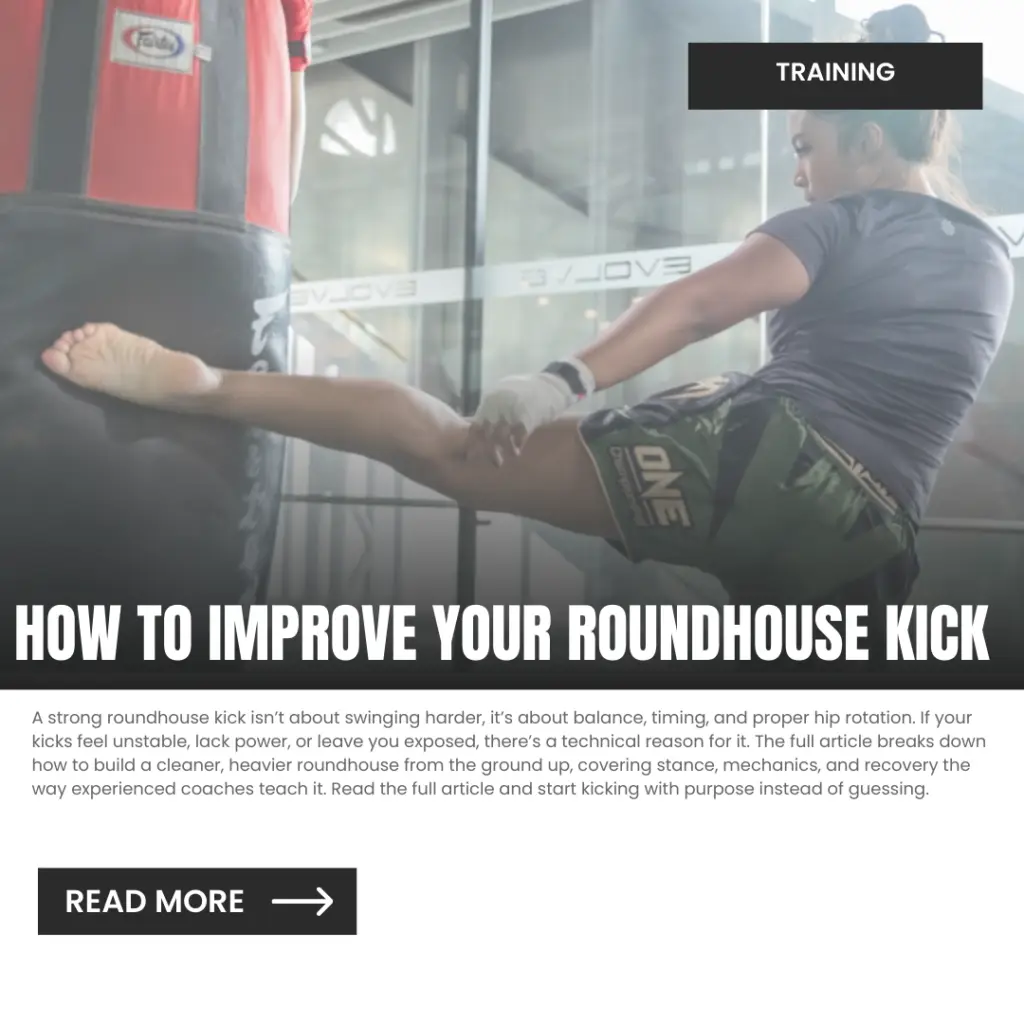
The roundhouse kick is one of the most powerful and versatile weapons in striking arts. Whether you practice Muay Thai, kickboxing, karate, or MMA, the roundhouse can end exchanges, control distance, and break down opponents over time. But power alone is not enough. A good roundhouse kick is built on mechanics, timing, balance, and repetition. Below is a break down on how to sharpen your roundhouse kick step by step.
TL;DR
Power starts from the ground, not the leg A strong roundhouse kick comes from proper stance, pivot, and hip rotation. If your base and hips are off, the kick will always be weak.
Relax, rotate, and strike through the target Keep the kicking leg loose, rotate your hips fully, and follow through. Don’t try to muscle the kick, let mechanics do the work.
Balance and recovery matter as much as impact A good kick leaves you stable and ready to move again. Hands up, controlled return, and clean recovery separate skilled kickers from reckless ones.
Understanding the Purpose of the Roundhouse
Before fixing technique, you need to understand intent. A roundhouse kick is not just about swinging your leg as hard as possible. It is a transfer of force from the ground, through your hips, into the target. When done correctly, the kick feels effortless yet heavy. When done poorly, it feels tiring and unstable.
Ask yourself what you want the kick to do. Are you aiming to score, to damage the leg, to force a guard reaction, or to finish? Purpose dictates placement, speed, and follow-through. Once you understand this, your training becomes focused instead of random.
Building a Solid Stance and Base
Every good kick starts from the floor. If your stance is weak, the kick will always be weak.
Your feet should be shoulder-width apart, knees slightly bent, and weight evenly distributed. Stay relaxed. Tension in the legs kills speed. Your heels should be light, ready to pivot. If you feel stuck to the floor, you won’t rotate properly.
A common mistake is standing too narrow. This causes loss of balance during rotation. Another mistake is leaning back too early. Keep your posture upright until the kick leaves the ground.
Drill this without kicking. Practice pivoting your support foot and rotating your hips while keeping your balance. This builds awareness and stability.
Hip Rotation: The Engine of the Kick
The hips are the engine. The leg is just the delivery system.
As you initiate the kick, turn your support foot outward. This opens the hips and allows full rotation. Your hips should swing through the target, not stop at it. Think of throwing your hip, not your leg.
Your shoulders should rotate with your hips. This keeps your body connected and increases power. If your upper body stays square while your hips turn, you lose force and strain your lower back.
Do slow kicks in front of a mirror. Watch your hip movement. Speed comes later. First, own the rotation.
image via Evolve MMA
Correct Leg Mechanics and Contact Point
Your kicking leg should be relaxed until the moment of impact. A stiff leg is slow and easy to read.
Lift the knee first, then extend the lower leg as the hips turn. This creates a whipping motion. Depending on your style, you may strike with the shin or the instep, but the principle remains the same: clean contact, not slapping contact.
A roundhouse kick that leaves you off-balance is a liability.
After the kick, snap the leg back or step down with control. Do not let gravity pull you. You should be ready to punch, kick again, or defend immediately.
Keep your hands up throughout the kick. Many students drop their guard as they focus on their legs. This is a bad habit that gets punished quickly in sparring.
Train recovery as much as the kick itself. Throw one kick, reset, and check your balance every time.
Drills That Actually Improve Your Kick
Quality drills matter more than quantity.
Slow-motion kicks: Build control and correct mechanics.
Heavy bag rounds: Focus on rotation and follow-through, not speed.
Balance drills: Kick and hold the chamber position before returning.
Avoid mindless repetition. Every kick should have intent.
Conditioning Without Destroying Your Technique
Strong hips, flexible hamstrings, and mobile ankles make a difference. Stretch after training. Strengthen your core and glutes to support rotation.
Do not chase fatigue at the expense of form. Ten clean kicks are better than fifty sloppy ones.
A strong roundhouse kick is built over time. There is no shortcut. Pay attention to your base, your hips, and your balance. Train with patience and honesty. Film yourself. Accept correction. The kick will improve if you respect the process.
Remember, power is not forced. It is transferred. When everything moves together, the roundhouse becomes one of the most reliable tools you will ever have.