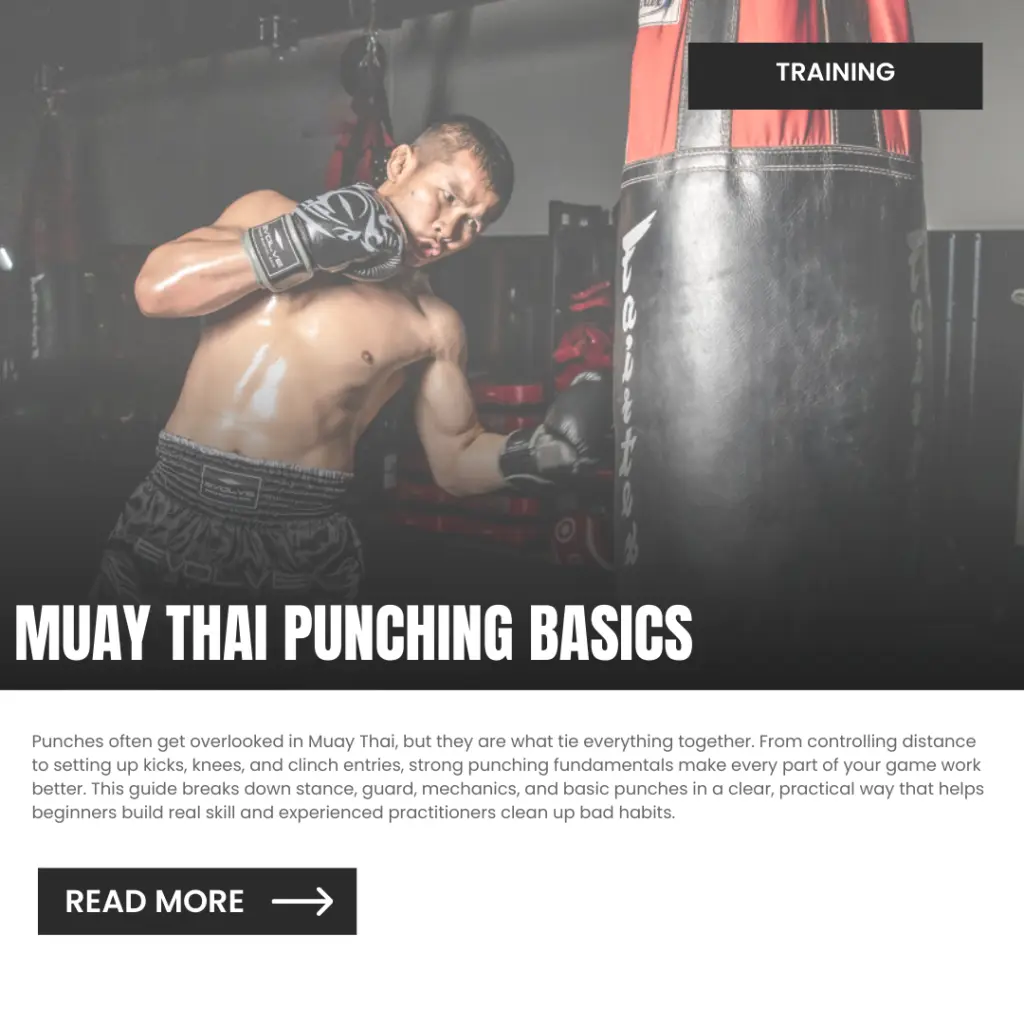
When most people think about Muay Thai, they think about kicks, knees, and elbows. Punches sometimes get overlooked, but they play a big role in how Muay Thai actually works. Punches help you control distance, set up stronger weapons, and stay safe during exchanges.
If you are new to Muay Thai, learning how to punch correctly will help you move better, stay balanced, and understand the flow of the art. Even experienced fighters often come back to these basics to clean things up. Let’s go through it step by step.
TL;DR
Introduction to Muay Thai Punching
Muay Thai is called the Art of Eight Limbs because it uses fists, elbows, knees, and kicks. Punches are only one part of that system, but they connect everything together.
In Muay Thai, punches are not thrown the same way as in pure boxing. You still want power, but balance and awareness matter more. Every punch you throw must respect the chance of getting kicked, kneed, or clinched.
Good punching fundamentals help you hit with control, recover faster, and stay ready for what comes next.
Stance and Guard Fundamentals
Your punches depend on your stance. If your stance is off, everything else will feel harder.
Proper Muay Thai Stance
Your feet should be about shoulder-width apart. The lead foot is slightly forward, heels light, and knees relaxed. Your weight should feel centered so you can check kicks or step quickly.
Hand Position and Guard
Hands stay high, around eye level. Elbows stay close to the body. This protects your head and body while keeping your hands ready to punch or block.
Chin and Elbow Position
Keep your chin slightly down. Do not stick it forward. Your shoulders and gloves should help shield your face.
Common Beginner Mistakes
Many beginners stand too tall, lock their knees, or let their hands drop when punching. These habits make you easier to hit and harder to recover.
Punching Mechanics
Punching power does not come from the arms alone.
Generating Power
Power starts from the ground. Push through your feet, turn your hips, rotate your shoulders, and then let the punch go. Everything moves together.
Weight Transfer and Balance
You shift your weight slightly with each punch, but you should never feel like you are falling forward. Staying balanced is more important than hitting hard.
Breathing
Exhale when you punch. This helps with timing and keeps you from tensing up.
Punch Recovery
After every punch, your hand comes straight back to guard. This is just as important as the punch itself.
Basic Muay Thai Punches
Jab (Mat Na)
The jab is the most used punch in Muay Thai.
Purpose: It helps you measure distance, interrupt your opponent, and set up other strikes.
Technique: Extend the lead hand straight out, turn the shoulder slightly, and pull the hand back fast.
Common Errors: Dropping the rear hand or leaning forward.
A good jab is quick and controlled.
Cross (Mat Trong)
The cross is your main power punch.
Power: Rotate the hips and shoulders and pivot the rear foot.
Follow-through: Do not over-rotate or fall forward.
Defense: Keep the lead hand up and protect your chin.
Hook (Mat Wiang San)
Hooks work best at closer range.
Horizontal and Diagonal Hooks: Diagonal hooks are often safer in Muay Thai because they keep your elbow tighter.
Alignment: Keep your wrist straight and elbow bent.
Targets: Head and body, especially the ribs.
Uppercut (Mat Soi Dao)
Uppercuts are useful when space is tight.
Close-range use: Throw them when your opponent is close or covering up.
Body and Head: Body uppercuts lift the guard. Head uppercuts follow.
Clinch use: Uppercuts can lead directly into clinch control.
Punching Targets in Muay Thai
Punches can go to the head or body. Body punches are important because they slow your opponent down and open the guard.
Legal targets include the face, head, and torso. Punches are often used to set up kicks, elbows, and knees. For example, punching high to land a low kick or punching to step into the clinch.
Defense While Punching
You should always think about defense when punching.
Maintaining Guard
The hand that is not punching stays up.
Head Movement
Small movements work best. Big slips can leave you open to kicks or knees.
Blocking and Parrying
Simple blocks and parries keep you safe without losing balance.
Avoiding Over-Commitment
If you miss, recover right away. Do not chase the punch.
Basic Punching Combinations
Keep combinations simple at first.
Jab-cross: The most basic and useful combo.
Punch to kick: Jab-cross into a low kick is common.
Punch into clinch: Punch, step in, and secure the clinch.
Drills: Practice slowly and focus on balance and clean form.
Training Tips for Beginners
Shadowboxing
Focus on stance, guard, and breathing.
Heavy Bag Work
Work on clean punches and balance, not just power.
Pad Work
Pay attention to timing and distance.
Common Mistakes
Using too much arm, rushing combinations, and dropping the guard.
Safety and Injury Prevention
Wrap your hands correctly and use gloves that fit. Warm up your shoulders, wrists, and hips before training. Do not lock your elbows or twist too hard when punching.
Punching fundamentals matter in Muay Thai. When your punches are solid, everything else becomes easier. Your kicks connect better, your clinch entries feel smoother, and your defense improves.
Train often, stay patient, and keep refining the basics. Strong fundamentals will carry you far in Muay Thai.